Construction project controls, consulting, and In Project AI
Why Weekly Project Reporting Is Critical for Construction Projects
Poor communication drives about a quarter of construction rework and puts billions at risk every year. Here is why a disciplined weekly reporting rhythm is one of the cheapest risk controls on a construction project, what owners should expect, and how to make it stick.
Article summary
Poor communication drives about a quarter of construction rework and puts billions at risk every year. Here is why a disciplined weekly reporting rhythm is one of the cheapest risk controls on a construction project, what owners should expect, and how to make it stick.
The short answer
Weekly reporting is critical because construction problems compound by the week. A late RFI becomes a late submittal, then a late delivery, then a missed milestone and a claim. A weekly report forces the team to look at cost, schedule, risk, and decisions often enough to catch those chains while they are still cheap to fix. It also gives the owner a predictable moment to make decisions instead of finding out at the monthly pay application that something went wrong three weeks ago.
What poor communication costs
The industry has measured the cost of poor information flow, and it is large.
| Finding | Source |
|---|---|
| Construction professionals spend about 35% of their time, more than 14 hours per week, on non-optimal activities such as searching for project data, resolving conflicts, and dealing with rework | FMI and PlanGrid, Construction Disconnected (2018) |
| Poor communication accounts for about 26% of construction rework, and poor project information for another 22% | FMI and PlanGrid, Construction Disconnected (2018) |
| These non-optimal activities cost the U.S. construction industry more than $177 billion per year | FMI and PlanGrid, Construction Disconnected (2018) |
| About $75 million of every $1 billion spent on projects is at risk from ineffective communication, and one in five projects is unsuccessful because of it | PMI Pulse of the Profession, The High Cost of Low Performance: The Essential Role of Communications (2013) |
These studies are not about weekly reports specifically. They show that the cost of not sharing the right information at the right time is real and measurable. A disciplined weekly report is one of the simplest ways to reduce it.
Five reasons weekly reporting matters
1. Problems are cheaper when they are young
A submittal that is five days late can usually be recovered with a phone call. At twenty days late it is driving a fabrication delay and a schedule claim. The weekly cycle is short enough to catch issues while recovery options are still available.
2. Owners need a predictable decision moment
Many delays are decision delays: a change waiting for approval, a design question waiting for an answer, a finish selection waiting for the owner. A weekly report with a decisions-needed list and dates turns those into explicit asks instead of background noise.
3. It keeps the forecast honest
A monthly-only forecast tends to absorb surprises in one large jump. Weekly attention to commitments, changes, and exposure keeps the forecast moving in small, explainable steps that owners trust. See our cost control guide for how the forecast is built.
4. It forces the logs to stay current
A report is only as good as the cost report, change log, RFI and submittal logs, schedule, and risk register behind it. A weekly deadline is what keeps those logs updated. Without it, logs drift until someone needs them for a dispute.
5. It builds a record
Fifty consistent weekly reports are a clear history of when issues were raised, what was asked of whom, and how the team responded. That record protects both owner and contractor if time or cost is challenged later.
What owners should expect from a weekly report
If you are an owner or owner's representative, these are reasonable expectations for any contractor or construction manager:
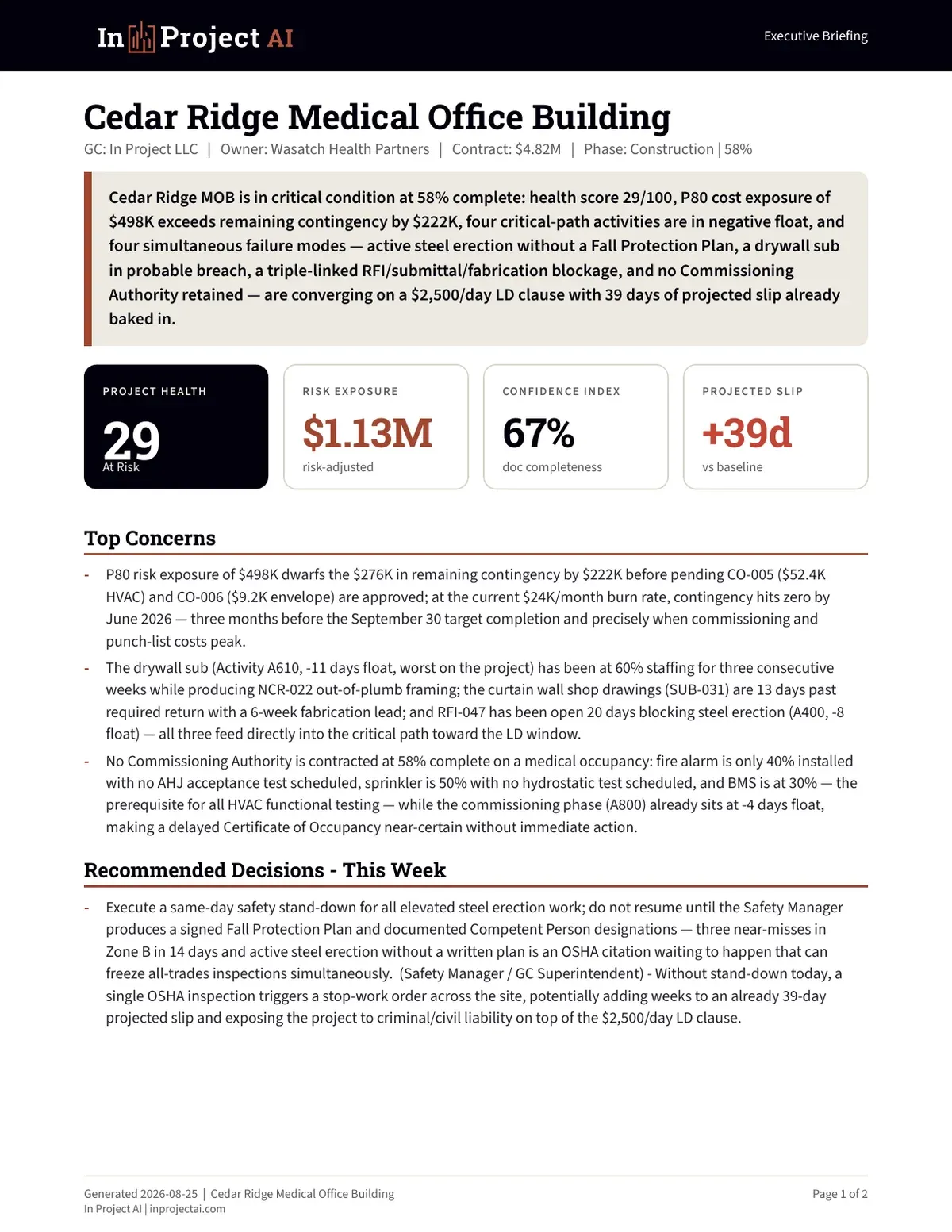
- One page up front with a clear status and the reason for it.
- The same handful of metrics every week, with last week's values for comparison.
- Milestone forecasts, not just percent complete.
- Forecast at completion with pending change exposure shown separately.
- Top risks with owners and actions, not just a list of concerns.
- A decisions-needed list naming who must decide and by when.
Signs your weekly reporting is not working
| Warning sign | Likely cause | Fix |
|---|---|---|
| Owners are surprised by cost at the pay application | Pending changes not reported weekly | Report pending exposure as its own line every week |
| Every week looks the same | Report describes activity, not status | Lead with status, movement, and decisions |
| Decisions keep slipping | No named decision owner or due date | Add a decisions-needed table with dates and impact |
| The report takes a day to write | Logs are updated only at report time | Fix the weekly log update schedule |
| Nobody reads past page one | Too long and unfocused | One-page summary with attachments |
| Statuses are all green until suddenly red | No defined thresholds | Write down what makes a status yellow or red |
A week in the life of a reported issue
To see why the cadence matters, follow a single issue on a mid-size project with and without a weekly report.
| Week | With weekly reporting | With monthly-only reporting |
|---|---|---|
| Week 1 | RFI on a steel connection is logged; required-by date shows it affects erection in 3 weeks | RFI is logged |
| Week 2 | Weekly report lists it under decisions needed from the architect with a due date | No visibility outside the project team |
| Week 3 | Still open; report escalates it and shows a 5-day float risk | RFI ages; fabricator waits |
| Week 4 | Answer received; fabrication proceeds with 2 days lost | Monthly report mentions the RFI after erection is already delayed |
| Outcome | 2 days recovered within float | 2 to 3 weeks lost, change order and schedule dispute likely |
Nothing in the weekly scenario required extra effort from the team. The same RFI was simply seen by the right people three times before it became a delay.
How to make weekly reporting stick
- Agree on the format at kickoff. Owner and contractor should sign off on the template, metrics, and status thresholds before the first report.
- Fix the calendar. Logs updated Monday and Tuesday, report published Wednesday, reviewed in the weekly owner meeting.
- Keep it short. One page plus attachments. Length is not thoroughness.
- Review it live. Walk through the report in the meeting, especially decisions and risks. A report nobody discusses is filed and forgotten.
- Close the loop. Every action and decision from last week should show its outcome this week.
- Automate the assembly. Use templates, connected logs, or AI tools so the PM spends time on judgment, not formatting.
For a section-by-section template and a filled-in example, see how to write a construction weekly project report.
Who benefits from weekly reporting
- Owners get early warning on cost and schedule and a clear list of decisions instead of surprises at the pay application.
- Contractors document that issues were raised on time, which protects change orders and schedule extensions.
- Design teams see which RFIs and submittals are truly urgent because each has a required-by date tied to the schedule.
- Lenders and program managers gain confidence that progress, cost, and risk are under control between monthly draws.
Weekly reporting in a tight labor market
With experienced project managers in short supply, many PMs now run more projects than they did a few years ago. That makes a consistent weekly rhythm more important, not less: it is how a stretched PM keeps every job visible without being on every site every day. It also makes it easier for a newer PM or a project controls consultant to step in, because the history and the open items are all in one place. We cover the wider workforce picture in the project management talent gap.
Where AI fits
Most of the effort in a weekly report is collecting and reconciling information that already exists. AI tools can now read cost reports, change logs, RFI and submittal logs, schedule updates, and daily reports, then draft the metrics, risks, and decisions sections and flag what changed since last week. In Project AI produces owner-ready reports this way. The project manager remains responsible for checking the numbers and the story before anything goes to the owner.
How In Project helps
In Project LLC helps owners and contractors set up reporting that owners trust: clear formats, defined thresholds, clean logs, and a weekly rhythm that holds up under pressure. Contact us about a reporting or project controls review.
Sources
- FMI and PlanGrid, Construction Disconnected: The High Cost of Poor Data and Miscommunication, 2018 (as reported by Construction Dive).
- Project Management Institute, Pulse of the Profession: The High Cost of Low Performance, The Essential Role of Communications, May 2013.
Frequently asked questions
Why is weekly reporting important in construction?
Construction issues compound quickly. A weekly report catches late RFIs, pending changes, slipping milestones, and open decisions while they are still cheap to fix, and gives the owner a predictable moment to decide.
Is weekly or monthly reporting better for construction projects?
Both. Weekly reporting drives near-term actions and decisions; monthly reporting explains the forecast, trends, and outlook, often alongside the pay application. Good weekly reports make the monthly report much easier.
What should an owner expect in a contractor's weekly report?
A one-page summary with clear status, consistent metrics with week-over-week movement, milestone forecasts, forecast at completion with pending changes shown separately, top risks with actions, and a list of decisions needed with dates.
How much does poor communication cost construction projects?
FMI and PlanGrid estimated in 2018 that non-optimal activities including searching for data, resolving conflicts, and rework cost the U.S. construction industry more than $177 billion a year, with poor communication behind about 26% of rework.