Construction project controls, consulting, and In Project AI
The Global Project Management Talent Crisis: A 30 Million Professional Shortfall by 2035
PMI projects the world will need up to 30 million more project professionals by 2035. U.S. construction already feels it: 76% of contractors with openings struggle to hire project managers. What the gap means for owners, contractors, and PMs, and how to respond.
Article summary
PMI projects the world will need up to 30 million more project professionals by 2035. U.S. construction already feels it: 76% of contractors with openings struggle to hire project managers. What the gap means for owners, contractors, and PMs, and how to respond.
Key takeaways
- PMI's Global Project Management Talent Gap report (May 2025) projects that up to 29.8 million more project professionals will be needed worldwide by 2035, on top of roughly 40 million working today.
- Demand for project professionals could grow by as much as 66% in construction, manufacturing, IT services, and healthcare.
- In the United States, 76% of construction firms with project manager or supervisor openings report difficulty filling them (AGC 2025 Workforce Survey).
- The Bureau of Labor Statistics projects 9% employment growth for construction managers from 2025 to 2035, about 49,700 openings per year, with median pay of $114,990.
- The practical response is a mix of hiring, developing people faster, standardizing project controls, and using AI to remove administrative work so experienced PMs can cover more ground.
What PMI found
In May 2025 the Project Management Institute (PMI) published its Global Project Management Talent Gap report. Using LinkedIn Talent Insights data across 172 project-related job titles in more than 180 countries, PMI estimated that there are almost 40 million project professionals in the global workforce today. Under its growth scenarios, organizations will need up to 29.8 million more by 2035.
To put that in perspective, PMI compares the project workforce with roughly 25 million software developers and about 30 million nurses worldwide. Project management is not a niche skill. It is one of the largest professional groups in the economy, and demand is still growing. The World Economic Forum's Future of Jobs Report 2025 ranks project manager as the 12th fastest-growing role globally through 2030.
PMI also expects demand to grow by as much as 66% in four sectors: construction, manufacturing, IT services, and healthcare. Construction is on that list because infrastructure investment, energy transition, data centers, housing, and healthcare facilities all depend on people who can plan, coordinate, and control complex work.
The gap in U.S. construction is already here
Global forecasts can feel abstract. U.S. contractor data is not. The Associated General Contractors of America (AGC) 2025 Workforce Survey, completed by 1,342 respondents in July and August 2025, found that four out of five firms had openings for salaried workers. Among firms with openings, the hardest roles to fill were on the project leadership side of the business.
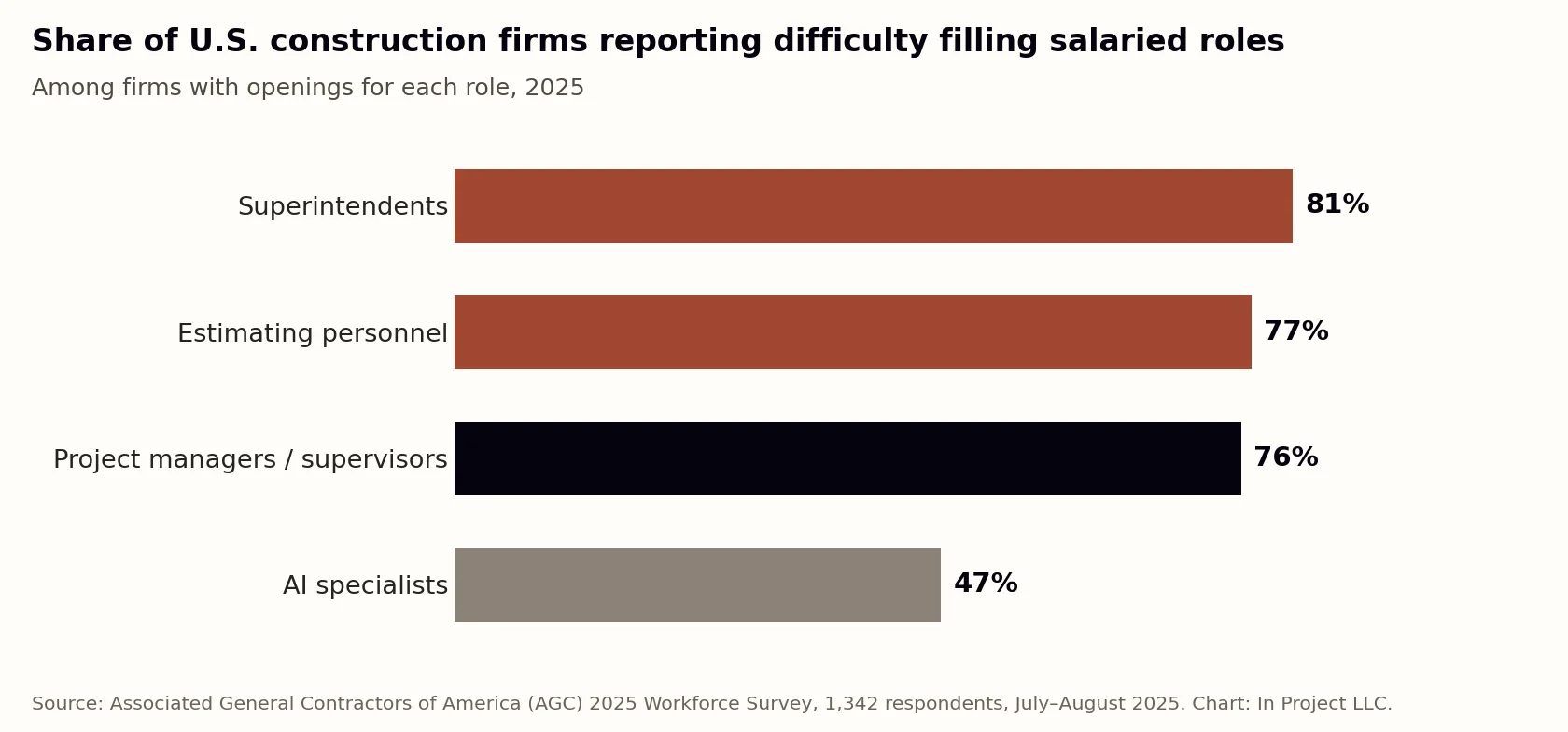
AGC also reported that 84% of firms with salaried openings said those roles were as hard or harder to fill than a year earlier, and 45% of firms said worker shortages, their own or their subcontractors', delayed at least one project in the past year. That share has fallen from 66% in 2022, but it still means nearly half of contractors lost time to staffing.
| Indicator | Value | Source |
|---|---|---|
| Construction manager median pay | $114,990 per year (May 2025) | U.S. Bureau of Labor Statistics |
| Construction manager jobs | 609,100 (2025) | U.S. Bureau of Labor Statistics |
| Projected growth | 9% from 2025 to 2035 | U.S. Bureau of Labor Statistics |
| Average annual openings | About 49,700 per year | U.S. Bureau of Labor Statistics |
| Firms struggling to fill PM and supervisor roles | 76% of firms with openings | AGC 2025 Workforce Survey |
| Firms with a project delayed by worker shortages | 45% | AGC 2025 Workforce Survey |
Why construction feels the gap harder than most industries
Every project is a temporary organization
A construction project assembles an owner, a design team, a general contractor, dozens of trade partners, suppliers, inspectors, and the authority having jurisdiction, then dissolves the team at closeout. Someone has to hold that temporary organization together. When experienced PMs are stretched across too many jobs, coordination is the first thing to slip.
Experience takes years to build
Reading a schedule, separating approved cost from pending exposure, negotiating a change, and knowing when an RFI is about to become a delay are skills learned on real projects. Many firms lost a generation of mid-career talent after the 2008 downturn, and the senior PMs who carried the industry since then are now approaching retirement.
The administrative load keeps growing
Owners expect more reporting, lenders want more documentation, and safety, quality, and sustainability requirements add paperwork every year. A large share of a PM's week goes to compiling logs and writing updates instead of solving problems. That is exactly the work that can be standardized or automated.
What the talent gap costs a project
Understaffed project teams rarely fail in one dramatic moment. The cost shows up as small control gaps that compound:
- Change orders wait weeks for a decision because nobody has time to price and negotiate them.
- RFIs and submittals age past their required dates and quietly push procurement and field work.
- Risk registers stop being reviewed, so known risks turn into active issues.
- Weekly reports become narrative summaries instead of decision tools, and owners lose confidence.
- Closeout drags because punch lists, warranties, and turnover documents have no clear owner.
Each of these is a project controls problem as much as a staffing problem. That is good news, because controls can be improved faster than a new PM can be hired and trained.
What owners and contractors can do now
- Standardize the controls system. Use one budget format, one change log, one RFI and submittal log, one risk register, and one weekly report template across projects. Standard tools let a new PM get productive in weeks, not months.
- Build a development path for assistant PMs and project engineers. Pair them with senior PMs on real controls tasks: updating the forecast, running the risk review, preparing the owner report.
- Capture lessons learned in a form people will reuse. A short list of what went wrong and how it was caught is more valuable than a long closeout report nobody reads.
- Protect PM time for decisions. Move log maintenance, report formatting, and meeting minutes to coordinators or automation so PMs spend their time on the issues only they can resolve.
- Use AI as a force multiplier, with review. AI tools can read schedules, budgets, logs, and daily reports and draft the risk register, forecast, and owner report. The PM reviews, corrects, and signs off.
- Bring in outside project controls support for peaks. Consultants and fractional project controls managers can cover a critical phase or a troubled job without a permanent hire.
How AI changes the project manager's job
AI will not replace project managers. It changes how their time is spent. The most useful applications today are the tedious, high-volume tasks: reading every open RFI and flagging the ones blocking the critical path, reconciling change logs with the budget, drafting the weekly report, and producing an action list with owners and dates.
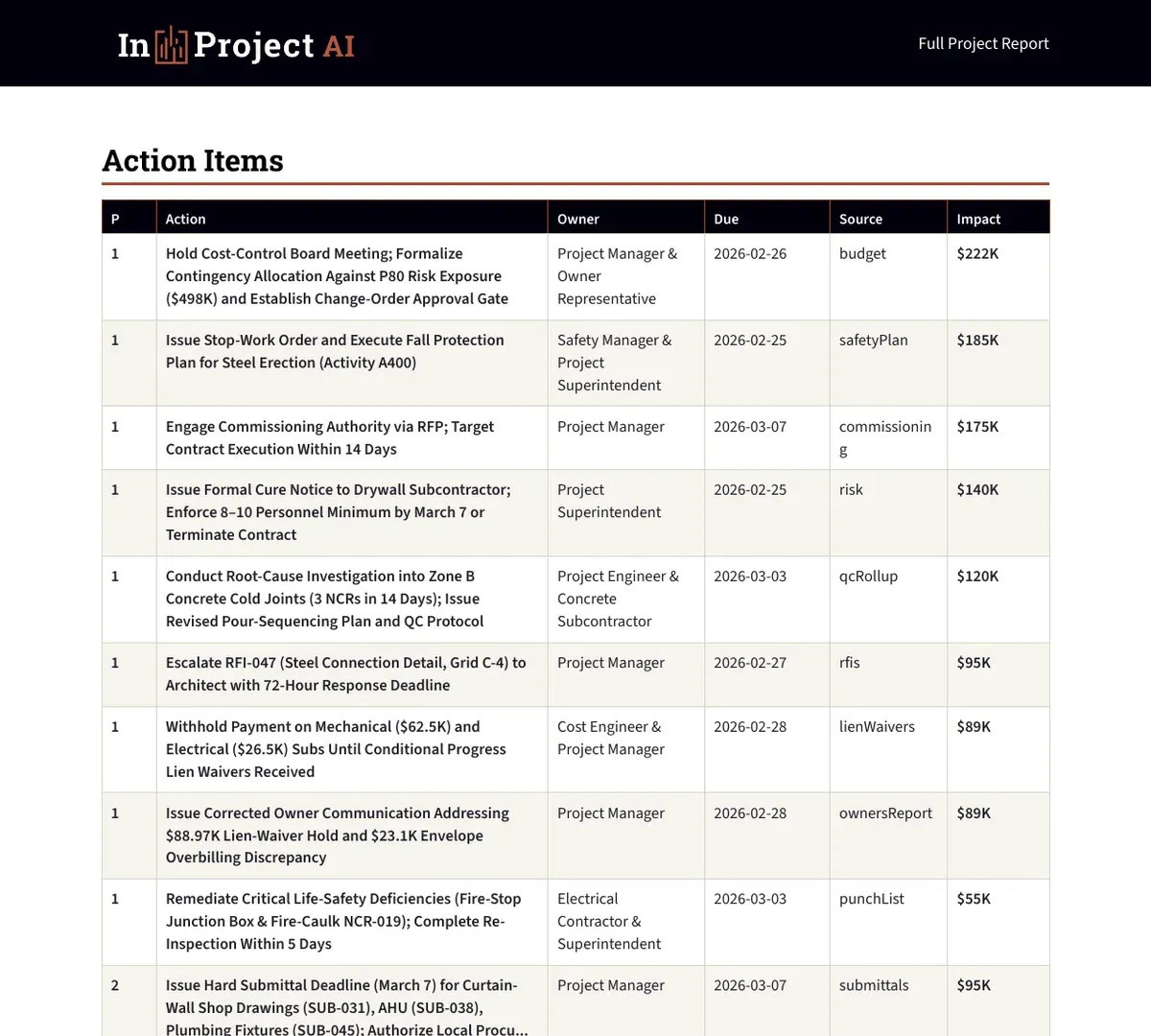
Used this way, AI lets one experienced PM keep closer control of more work, and it helps newer PMs see what a strong controls review looks like. The guardrails matter: every output needs professional review, the source documents must be correct, and decisions stay with accountable people.
Skills construction project managers will need by 2035
| Skill area | Why it matters |
|---|---|
| Cost forecasting and change control | Budgets move through changes; PMs must explain the forecast, not just the actuals |
| Schedule and constraint management | Most delays start as a late document, decision, or delivery |
| Risk management | Owners expect risks to be scored, owned, and actively mitigated |
| Data and AI fluency | PMs will review AI-generated analysis and must spot errors and gaps |
| Owner and executive communication | Clear, short, decision-focused reporting builds trust |
| Leadership and coaching | Senior PMs must develop the next generation faster |
For individuals, credentials such as the PMP, a construction management degree, or a CCM help, but employers consistently value demonstrated control of real projects most. Keep a record of the budgets, schedules, and outcomes you managed.
How In Project helps
In Project LLC helps owners and contractors get more out of the project teams they already have. We set up practical project controls, reporting rhythms, and dashboards, and In Project AI turns your schedules, budgets, logs, and daily reports into risk registers, forecasts, and owner-ready reports for professional review. If your team is stretched, contact us about a project controls review or short-term support.
Sources
- Project Management Institute, Global Project Management Talent Gap report and press release, May 7, 2025.
- World Economic Forum, Future of Jobs Report 2025.
- Associated General Contractors of America, 2025 Workforce Survey Analysis.
- U.S. Bureau of Labor Statistics, Occupational Outlook Handbook: Construction Managers.
Figures are reported as published by each source. Forecasts depend on economic scenarios and should be read as ranges, not guarantees.
Frequently asked questions
How big is the project management talent gap?
PMI estimates there are almost 40 million project professionals worldwide today and that up to 29.8 million more will be needed by 2035, depending on economic growth.
Is there a shortage of construction project managers in the United States?
Yes. In the AGC 2025 Workforce Survey, 76% of construction firms with project manager or supervisor openings reported difficulty filling them, and 45% said worker shortages delayed at least one project in the past year.
What do construction managers earn in the U.S.?
The Bureau of Labor Statistics reports median annual pay of $114,990 for construction managers as of May 2025, with about 49,700 openings projected each year from 2025 to 2035.
Will AI replace construction project managers?
No. AI is useful for reading documents, flagging risks, and drafting reports, but contracts, relationships, safety, and final decisions still require experienced, accountable professionals. AI lets each PM cover more ground.
How can a contractor cope with a shortage of project managers?
Standardize project controls so new PMs ramp up faster, develop assistant PMs on real controls tasks, protect senior PM time for decisions, use AI to remove administrative work, and bring in outside project controls support during peaks.