Construction project controls, consulting, and In Project AI
Construction Project Controls in Utah: A Guide for Owners and Developers
What owners, developers, and contractors building in Utah should know about project controls: the market drivers along the Wasatch Front, labor and cost pressures, Utah's State Construction Registry and lien deadlines, winter and permitting risks, and a practical controls checklist for Utah projects.
Article summary
What owners, developers, and contractors building in Utah should know about project controls: the market drivers along the Wasatch Front, labor and cost pressures, Utah's State Construction Registry and lien deadlines, winter and permitting risks, and a practical controls checklist for Utah projects.
Why Utah projects need strong project controls
Utah has been one of the fastest-growing states in the country, and the Wasatch Front, from Ogden through Salt Lake City and Lehi to Provo, carries most of that growth. Data centers, semiconductor and advanced manufacturing, energy, transit, housing, healthcare, and preparations for the 2034 Olympic and Paralympic Winter Games all compete for the same contractors, trades, and materials.
That combination of demand, tight labor, and seasonal weather makes cost and schedule control especially important. This guide covers what owners, developers, and contractors should plan for on Utah projects, and the controls that keep them on track. It is written from our experience as a project controls consulting firm based in Salt Lake City.
Utah market drivers in 2026
| Driver | Examples |
|---|---|
| Technology and advanced manufacturing | Data centers; semiconductor investment such as Texas Instruments in Lehi |
| Energy and power | Operation Gigawatt, the state's initiative launched in 2024 to expand energy production |
| Transportation and transit | Salt Lake City International Airport redevelopment phases; FrontRunner and TRAX improvements |
| Mixed-use and redevelopment | The Point at the former prison site in Draper; downtown Salt Lake City projects |
| 2034 Winter Games | Salt Lake City–Utah was selected in July 2024 to host the 2034 Olympic and Paralympic Winter Games; transportation and public-realm projects are planned ahead of the Games |
| Housing | A statewide shortage estimated in the tens of thousands of units and a state goal for new starter homes |
Local economists at the University of Utah's Kem C. Gardner Policy Institute projected continued construction job growth in 2026, and industry leaders expect wages in several trades to keep rising. For owners, that means competition for good subcontractors and upward pressure on labor cost, both of which belong in the budget and the risk register from day one.
Key risks on Utah construction projects
Labor availability and cost
Utah's low unemployment rate and heavy construction pipeline make skilled trades and experienced superintendents hard to find. Nationally, the AGC 2025 Workforce Survey found that 76% of firms with project manager or supervisor openings had trouble filling them. Track crew sizes against plan every week; a short-staffed trade is often the first sign of a schedule problem.
Winter weather and elevation
Winters along the Wasatch Front bring snow, freezing temperatures, and inversions, and projects at higher elevations face longer, harsher seasons. Concrete, masonry, roofing, and site work need cold-weather plans, temporary enclosures, and heat. Build realistic weather days into the schedule and carry winter protection as a budget line, not a surprise change order.
Permitting and inspections
Fast-growing cities and counties can have heavy permit and inspection workloads. Meet early with the authority having jurisdiction, keep a three-week inspection look-ahead, and track permit milestones in the schedule. See our three-week look-ahead guide.
Long-lead equipment
Data center, industrial, and healthcare projects depend on switchgear, transformers, generators, and air handlers with long lead times. Release orders early, track submittal approvals against delivery needs, and put each long-lead item in the risk register.
Geotechnical and site conditions
Utah sites can include shallow groundwater, variable soils, and seismic design requirements along the Wasatch Fault. Invest in geotechnical investigation and carry contingency for unforeseen conditions.
Owner decision speed
In a busy market, contractors and trades move to the next job quickly. Slow owner decisions on changes, finishes, or design questions cost more here than in a slow market, because crews may not be available when the answer finally comes. A decisions-needed list with dates in every weekly report is one of the cheapest protections an owner has.
A seasonal planning calendar for the Wasatch Front
| Season | Typical considerations | Controls actions |
|---|---|---|
| Spring | Wet soils, snowmelt, start of the main building season | Confirm site drainage and earthwork sequence; lock subcontract buyout before peak demand |
| Summer | Peak productivity; high trade demand; heat | Maximize envelope and site work; watch crew availability and overtime cost |
| Fall | Race to dry-in before winter | Prioritize roofing, windows, and temporary enclosures; order winter protection early |
| Winter | Snow, cold, inversions, shorter days; harsher at higher elevations | Shift to interior work; budget heat and enclosures; add weather days to the schedule |
Projects that are fully enclosed before winter usually hold their schedules far better than those still waiting on roofing or glazing when the first storms arrive. Build that milestone into the baseline schedule and track it in every weekly report.
Utah's State Construction Registry and lien deadlines
Utah handles construction notices through the State Construction Registry (SCR), an online system administered by the state. Owners and contractors should understand the key deadlines because they affect payment, lien rights, and closeout.
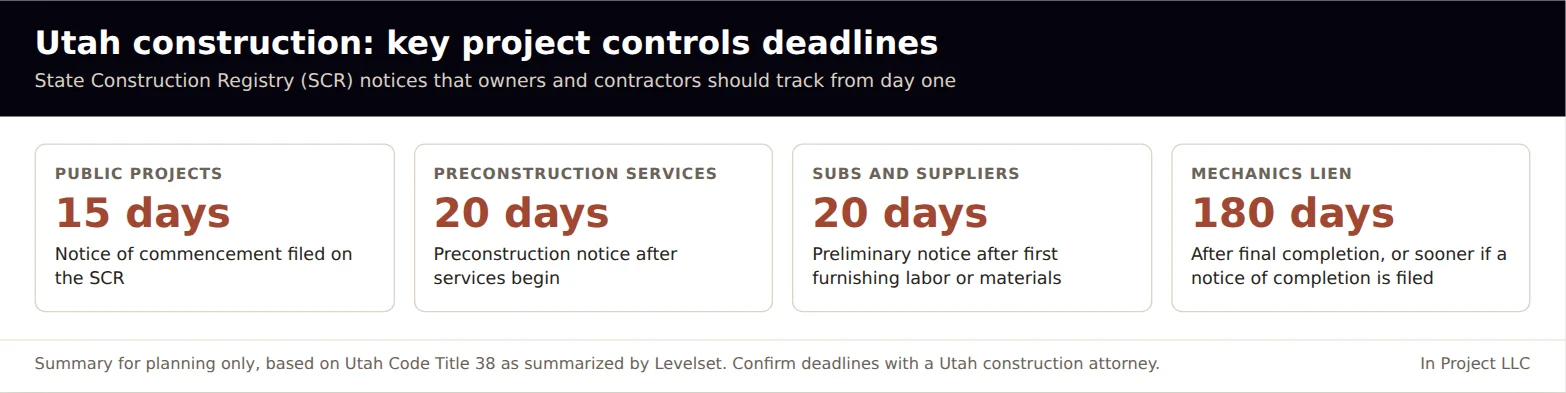
- Preliminary notice. Subcontractors and suppliers generally file a preliminary notice on the SCR within 20 days after first furnishing labor or materials.
- Preconstruction notice. Design and other preconstruction service providers file within 20 days after starting those services.
- Notice of commencement. On public projects, a notice of commencement is filed on the SCR within 15 days of starting work.
- Mechanics lien. A lien generally must be recorded within 180 days after final completion, or within a shorter period if a notice of completion is filed.
For owners, the practical takeaway is to check the SCR for preliminary notices, match them to the subcontractor list, and require lien waivers from those parties with each payment. Our pay application review guide covers the waiver process. This is general information, not legal advice; confirm requirements with a Utah construction attorney.
A project controls checklist for Utah projects
- Budget with Utah realities. Include winter protection, escalation for labor and materials, and contingency sized to design completeness and site risk.
- Schedule with weather and inspections. Add weather days by season and an inspection look-ahead; identify long-lead items early.
- Start a risk register at kickoff. Labor, winter, permits, long-lead equipment, site conditions, and owner decisions.
- Set up the change process. Agree on notice times, markups, and decision deadlines before work starts. See our change order guide.
- Track the SCR. Match preliminary notices to subcontractors and require waivers with every payment.
- Report weekly. One-page status, forecast at completion, pending exposure, top risks, and decisions needed.
- Track crews against plan. Labor shortfalls are an early warning in this market.
- Plan closeout early. Start turnover, commissioning, and lien release tracking 90 days before substantial completion.
Owner's representative and project controls support in Utah
Many owners and developers, especially those building their first large project in Utah or managing several projects at once, use an owner's representative or project controls consultant. The role typically includes budget and forecast management, schedule review, change order and pay application review, risk management, and owner reporting. A good owner's representative pays for itself by catching overbilling, unpriced changes, and schedule slips early.
| Situation | Why support helps |
|---|---|
| First major project for the owner | Sets up budgets, contracts, and reporting correctly from the start |
| Multiple projects at once | Consistent reporting and portfolio visibility |
| Project already behind or over budget | Independent forecast and recovery plan |
| Lender or investor reporting | Credible, consistent monthly reports and draw reviews |
| Complex MEP, data center, or healthcare work | Long-lead, commissioning, and change exposure tracking |
How In Project helps Utah owners and contractors
In Project LLC is a project controls consulting firm based in Salt Lake City, led by Narciso Dickson, MS, PMP. We support owners, developers, general contractors, and subcontractors across Utah with project controls setup, budget and schedule review, change order and pay application review, risk registers, and owner-ready reporting. In Project AI adds AI-assisted analysis of your schedules, budgets, logs, and daily reports for faster, more consistent reviews. Learn more about our project controls services or contact us to talk about your Utah project.
Sources
- Utah Construction & Design, 2026 Economic Outlook (Kem C. Gardner Policy Institute, AGC of Utah, Zions Bank, and others).
- Associated General Contractors of America, 2025 Workforce Survey Analysis.
- Utah State Construction Registry rules as summarized by Levelset, Utah Preliminary Notice and Mechanics Lien guides.
- International Olympic Committee and Salt Lake City–Utah 2034 announcements.
Frequently asked questions
What is the Utah State Construction Registry?
The State Construction Registry (SCR) is Utah's online system for filing construction notices, including preliminary notices, preconstruction notices, notices of commencement on public projects, and notices of completion.
What is the preliminary notice deadline in Utah?
Subcontractors and suppliers generally must file a preliminary notice on the State Construction Registry within 20 days after first furnishing labor or materials. Confirm specific requirements with a Utah construction attorney.
How long do you have to file a mechanics lien in Utah?
Generally within 180 days after final completion of the original contract, or a shorter period if a notice of completion is filed. Deadlines are strict, so confirm with an attorney.
What are the biggest risks on Utah construction projects?
Skilled labor availability and rising wages, winter weather, permit and inspection timing in fast-growing cities, long-lead electrical and mechanical equipment, and geotechnical and seismic conditions.
Do I need an owner's representative for a construction project in Utah?
Not always, but owners building their first large project, managing several projects, reporting to lenders or investors, or delivering complex MEP, data center, or healthcare work often benefit from independent project controls and owner's representative support.