Construction project controls, consulting, and In Project AI
Construction Change Order Management: A Step-by-Step Process That Prevents Disputes
How to manage construction change orders from first notice to executed change: the 7-step process, what belongs in a change order log, how to review pricing and time impact, how to track pending exposure and decision aging, and the mistakes that turn changes into claims.
Article summary
How to manage construction change orders from first notice to executed change: the 7-step process, what belongs in a change order log, how to review pricing and time impact, how to track pending exposure and decision aging, and the mistakes that turn changes into claims.
Why change orders cause so many problems
Almost every construction project has changes: owner requests, design revisions, unforeseen conditions, code interpretations, and coordination fixes. Changes themselves are normal. Problems start when they are identified late, priced slowly, decided even more slowly, and tracked in email instead of a shared log. That is when pending cost builds up unseen, schedule impacts get argued after the fact, and a simple change becomes a claim.
A clear change order process does not stop changes from happening. It makes them visible early, keeps pricing fair and supported, gets decisions made on time, and keeps the budget, schedule, and pay applications aligned.
Key terms
| Term | Meaning |
|---|---|
| Potential change order (PCO) | An event that may change cost or time, logged as soon as it is identified |
| Change order request (COR) | The contractor's priced proposal for a change |
| Change order (CO) | The signed agreement adjusting contract sum, contract time, or both |
| Construction change directive (CCD) | Owner direction to proceed before price or time is agreed |
| Pending exposure | Value of potential and requested changes not yet approved |
| Decision aging | How long a change has been waiting for a decision |
Terminology varies by contract form, so use the terms in your agreement consistently in the log and reports.
The 7-step change order process
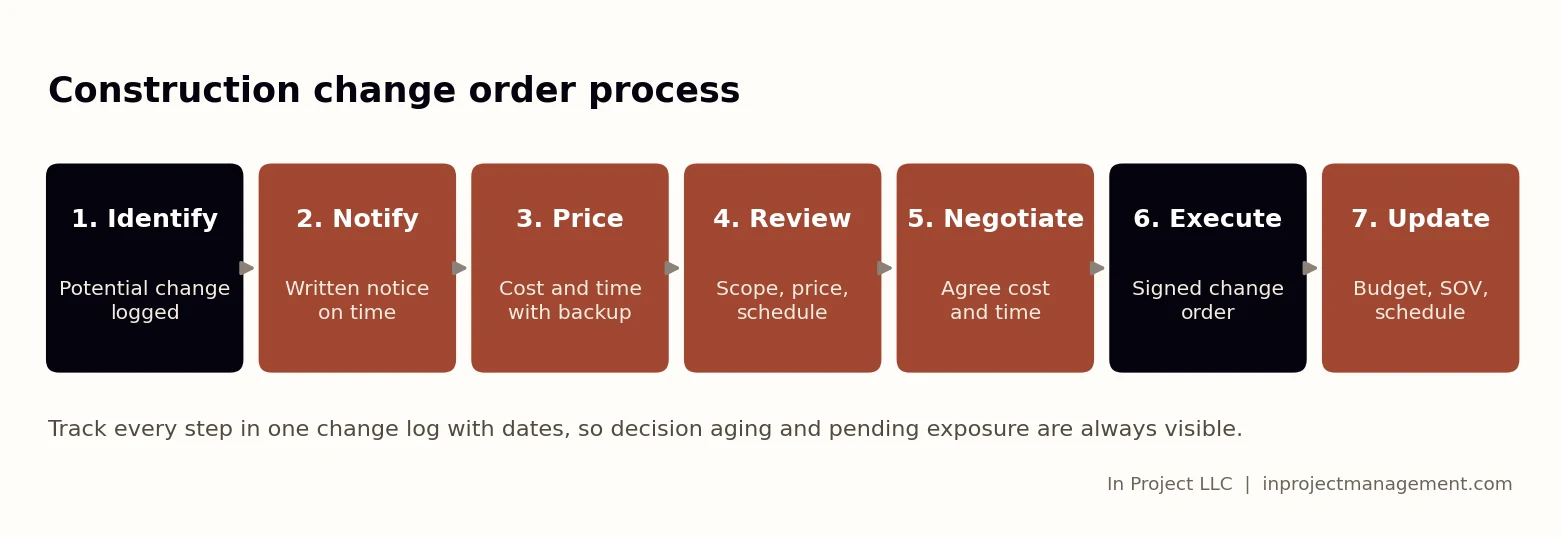
- Identify. Log every potential change as soon as it is known, with a short description, cause, and rough order of magnitude. Do not wait for a price.
- Notify. Give written notice within the time the contract requires. Late notice is one of the most common reasons legitimate changes are rejected.
- Price. Prepare a proposal with labor, material, equipment, subcontract, markup, and any time impact, with quotes and backup attached.
- Review. Check entitlement against the contract documents, quantities and rates against the estimate, and the time impact against the schedule.
- Negotiate. Resolve differences quickly. If the work cannot wait, use a construction change directive and agree on price and time afterward.
- Execute. Sign the change order with the agreed cost and time. Only executed changes go on the pay application.
- Update. Revise the budget, schedule of values, schedule, and forecast, and close the item in the log.
What belongs in a change order log
| Column | Purpose |
|---|---|
| Number and title | Reference for meetings and correspondence |
| Cause | Owner request, design error or omission, unforeseen condition, regulatory, value engineering |
| Date identified and date notice sent | Supports timely notice and aging |
| Status | Potential, requested, under review, approved, rejected, directed |
| Estimated value and proposed value | Shows exposure before pricing is final |
| Approved value | Executed amount that adjusts the contract sum |
| Time impact requested and approved | Days added to contract time, if any |
| Ball in court and due date | Who owes the next action and when |
| Days open | Decision aging for escalation |
How to review change order pricing
Entitlement first
Before looking at numbers, confirm the work is actually a change. Check the specifications, drawings, and scope of the original contract and any bid clarifications. Many disputes come from pricing work that was already included.
Then the price
- Quantities match the drawings or field measurements.
- Labor rates and productivity are consistent with the contract and current conditions.
- Material prices are supported by quotes or invoices.
- Equipment rates follow the agreed rate source.
- Markups for overhead, profit, bonds, and insurance follow the contract percentages and are not applied twice through subcontract tiers.
- Credits for deleted work are included where scope is removed.
Then the time
A time extension request should show which schedule activities are affected, whether they are on the critical path, and how many days the completion date moves. Requests without a schedule analysis are hard to evaluate and easy to dispute.
Track pending exposure and decision aging
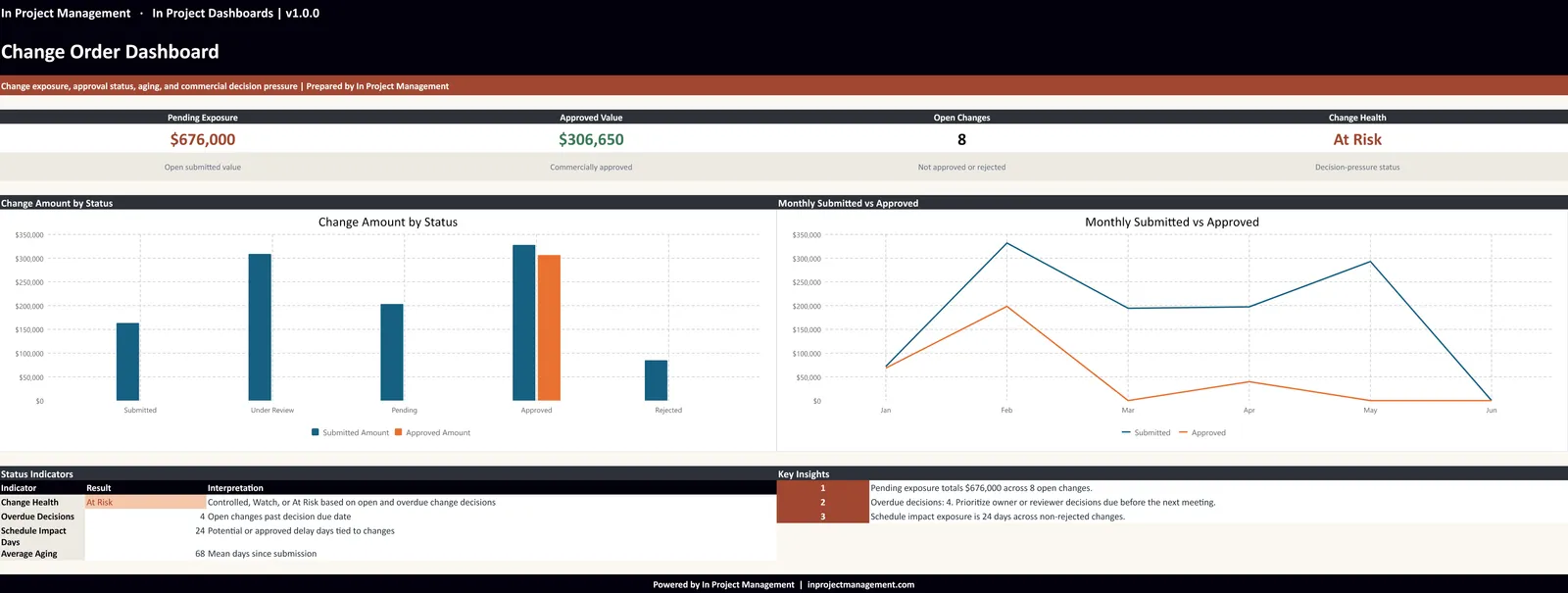
The two numbers owners most need from the change log are pending exposure and decision aging. Pending exposure tells them how much cost is likely but not yet approved. Decision aging tells them which items are holding up work. Report both every week.
| Days open | Number of items | Value | Action |
|---|---|---|---|
| 0 to 15 | 6 | $84,000 | Normal review |
| 16 to 30 | 4 | $112,500 | Follow up in weekly meeting |
| 31 to 60 | 2 | $61,600 | Escalate to owner and design team |
| Over 60 | 1 | $38,000 | Executive decision or directive |
Show pending exposure next to the forecast in the cost report, as explained in our cost control guide, so leaders see the risk-adjusted forecast and not only approved changes.
Common causes of change orders
| Cause | Example | How to reduce it |
|---|---|---|
| Owner-requested changes | Added scope, upgraded finishes, layout changes | Freeze decisions at defined milestones; price options early |
| Design errors and omissions | Conflicting drawings, missing details | Constructability and coordination reviews before bidding |
| Unforeseen conditions | Rock, contaminated soil, hidden existing conditions | Geotechnical and existing-condition surveys; owner contingency |
| Regulatory and code | Inspector or fire marshal requirements | Early meetings with the authority having jurisdiction |
| Value engineering | Alternative systems or materials | Evaluate life-cycle cost and schedule effect, not only first cost |
| Schedule acceleration | Owner-directed acceleration to recover time | Decide early; compare acceleration cost with delay cost |
Tracking the cause of every change also builds useful data. After a few projects you will know whether design completeness, owner decisions, or site conditions drive most of your changes, and you can target the root cause on the next job.
Owner and contractor responsibilities
| Party | Key responsibilities |
|---|---|
| Owner | Make decisions on time; provide direction in writing; fund approved changes; track pending exposure against contingency |
| Architect or engineer | Answer RFIs and clarify scope promptly; review change requests for design intent; issue revised documents |
| General contractor or CM | Give timely notice; price with backup; analyze schedule impact; keep the log current; coordinate subcontractor pricing |
| Subcontractors | Notify the contractor promptly; provide detailed pricing and backup; do not proceed without written direction |
Change order KPIs worth tracking
- Total approved changes as a percentage of the original contract value.
- Pending exposure as a percentage of remaining contingency.
- Average days from request to decision.
- Number of changes over 30 days without a decision.
- Share of changes by cause.
How to prevent change order disputes
- Agree at kickoff on the change process, forms, markups, rate sources, and response times.
- Log potential changes immediately, even without a price.
- Send written notice on time, every time.
- Require backup for every price and a schedule analysis for every time request.
- Review changes weekly with the owner and design team.
- Use construction change directives when work cannot wait, then close them out quickly.
- Never bill unapproved changes on the pay application.
- Keep the log, cost report, schedule, and schedule of values in sync.
Common change order mistakes
| Mistake | Consequence | Fix |
|---|---|---|
| Waiting to log a change until it is priced | Owner learns about exposure too late | Log at identification with a rough estimate |
| Missing contractual notice deadlines | Valid changes rejected | Track notice dates in the log |
| Proceeding on verbal direction | Disputes over scope and price | Use written direction or a change directive |
| Ignoring time impact until later | Schedule claims at closeout | Analyze time with every change |
| Letting decisions sit for weeks | Delays and acceleration costs | Report decision aging weekly and escalate |
Using AI to review change orders
Change order review involves reading the request, the specification, the drawings, the pricing backup, and the schedule. AI tools can summarize a request, compare it with the contract language you provide, check math and markups, and list questions for the reviewer. In Project AI includes a change order module that tracks value against the contract, flags scope creep, and estimates cost and schedule impact for professional review. Entitlement and final decisions remain with the project team. For more, see 10 AI workflows for construction PMs.
How In Project helps
In Project LLC helps owners and contractors set up change management processes, change logs, and reporting that keep exposure visible and decisions moving. Contact us for a project controls review or owner's representative support.
Frequently asked questions
What is a change order in construction?
A change order is a written agreement between the owner and contractor that changes the scope of work, the contract sum, the contract time, or a combination of these after the contract is signed.
What is the change order process in construction?
Identify the potential change, give written notice, price the cost and time impact with backup, review entitlement and pricing, negotiate, execute the signed change order, then update the budget, schedule, schedule of values, and forecast.
What should a change order log include?
Number and title, cause, date identified and notice date, status, estimated, proposed, and approved values, time requested and approved, who owes the next action, and how many days the item has been open.
What is a construction change directive?
A construction change directive is a written order from the owner directing the contractor to proceed with a change before the price or time adjustment is agreed. The adjustment is settled afterward.
How can owners reduce change order costs?
Invest in complete design documents and constructability review, define the change process and markups in the contract, make decisions quickly, review pricing carefully, and track pending exposure weekly.